Posts tagged with #Performance
33 posts

When Your Frontend Needs to Process Files, Not Just Upload Them: Diving into WebAssembly
Sending user-generated files to a backend for processing often feels like the default, but it's not always the best solution. We'll explore how WebAssembly lets us handle complex file operations directly in the browser, boosting privacy and performance.

When Your React State Is Lying to You: Derived State Done Right
It's easy to fall into the trap of syncing a computed value into `useState`, leading to stale UI, extra renders, and subtle bugs. Let's fix derived state.

When Your UI Needs to Be Truly Cross-Platform: Diving into Tamagui
Building a truly performant and consistent UI across web and native platforms has always been a tightrope walk. You either compromise on native feel, or you double your effort. Tamagui promises a different path: compile-time optimization, styled components, and a shared core that feels right everywh

When Your React App Renders Twice and No One Knows Why: Understanding Hydration
Ever built a React app that seems to flicker on load, or worse, throws hydration errors that make no sense? You're not alone. I've been down the React hydration rabbit hole, and it's a critical concept for anyone building performant and stable server-rendered React applications.

When Your Spreadsheet Lies: Building a Battery Calculator That Understands Chemistry
Off-grid power systems are a hot topic, but most battery calculators miss the crucial details of battery chemistry, leading to over-spec'd or underperforming systems. Let's build a calculator that accounts for discharge curves and Peukert's law, giving you real-world capacity.

When Your Frontend Needs to Get Crafty: Image Processing and Generative Art in the Browser
Pushing complex image processing and generative art into the browser might seem like a performance nightmare, but with modern web APIs, it's more feasible and powerful than you think. Let's build a tool that turns photos into pixel art, exploring how we can harness Web Workers and the Canvas API to

When Your Frontend Gets Creative: Image Processing in the Browser with WebAssembly
Pushing complex image processing directly to the client can seem daunting. But with WebAssembly, we can unlock serious computational power without hitting a server, opening doors for creative, responsive tools.

When Your CSS Framework is Bloated, But You Still Want Utility Classes: UnoCSS
I've been a Tailwind user for years, but the build times and the sheer size of the generated CSS are starting to wear thin. UnoCSS promises the best of both worlds: utility-first CSS, but with an instant, on-demand engine that keeps your stylesheets lean.

When Your Tiny Package Has a Secret Dependency Hoard
You built a small, focused React component. It's 4KB. You push it to npm. Then you look at the dependency tree and realize it's pulling in half the internet. What happened? And how do you fix it before your users pay the price?

When Your Mobile Camera Needs to Be More Than Just a Photo Button
React Native's built-in camera capabilities are fine for simple snapshots, but what if you need real-time computer vision, custom effects, or advanced control over the sensor? That's where libraries like react-native-vision-camera come in. It lets you tap into the raw power of the device camera, ope

When Your UI Needs to Break the Flat Screen: React and 3D with React Three Fiber
We've been building UIs on flat screens for decades. But what happens when you need something more? When data visualization demands depth, or an interactive product showcase needs a real sense of presence? React Three Fiber is the tool that lets you bring the full power of Three.js into your React a

When Next.js Cache Components Refuse to Build Your App
Next.js 16.3 introduced 'Cache Components' to optimize server-side rendering, but getting them to work can be a headache. I spent a frustrating afternoon debugging why a simple page wouldn't build, only to uncover some subtle yet critical design considerations. It turns out, this feature forces you

Vite: When Your Dev Server Needs to Be as Fast as Your Code
We've all been there: waiting for a dev server to spin up, or watching HMR take precious seconds to reflect a simple CSS change. It breaks flow, kills productivity, and makes you wonder if you should just switch to a static HTML file. Vite changed that for me, fundamentally altering how I think abou

When Your Frontend Accidentally Becomes a DDOS Attack
A seemingly innocent React change can sometimes unleash a storm of API requests, bringing down your backend. This isn't just about performance; it's about understanding how your UI choices translate to server load, and how a small oversight can have catastrophic effects.

React's useEvent: The Stable Callback You've Been Waiting For
React developers constantly battle stale closures and the performance overhead of `useCallback`. The `useEvent` hook, though not yet stable, offers a potential solution for stable event handlers without the dependency array dance. It's a game-changer for component architecture and performance.

Tamagui: When Your Universal Design System is a Performance Obsession
Building truly universal components for web and native often means sacrificing performance or developer experience. Tamagui offers a radical alternative: a compiler-driven approach that optimizes styles while providing a unified API.

useMeasure and ResizeObserver: When Your UI Needs to Know Its Own Size
Often, your UI components need to react to their own dimensions, not just window size. The `ResizeObserver` API, combined with a custom React hook like `useMeasure`, is the robust solution for this, letting components adapt dynamically without complex hacks.

When Your Frontend Needs a Dedicated CPU: Offloading to Web Workers with Comlink
You've got a complex calculation, an intensive image manipulation, or maybe just a really big data transformation. You throw it into an async function, sprinkle in an 'await', and hope for the best. But when that 'best' still means a janky UI and frustrated users, it's time to give that heavy liftin

Astro: When Your "Static" Site Needs to Be More Than Just Static
For years, we've debated static vs. dynamic, SSR vs. CSR. Astro offers a compelling third path for content-driven sites, letting you ship zero JavaScript by default while still pulling in interactive islands where you need them. It's a pragmatic approach to performance that rethinks how we build for

Optimistic UI: When Reality Bites Back (and How to Fix It)
Optimistic UI is a powerful pattern, but it's not without its gotchas. I'll show you how to handle a subtle race condition that can lead to inconsistent states, especially when users interact rapidly.

Optimistic UI: When Reality Bites Back (and How to Fix It)
Optimistic UI feels like magic, but what happens when network requests fail or users go wild with clicks? Let's dive into how to build robust optimistic updates that don't fall apart under pressure.

Rust for Desktop: When Database Clients Aren't Bloated Electron Apps
I've grown tired of the memory bloat and slow startups of modern desktop applications, especially database clients. Rust offers a compelling alternative for building performant, native tools that respect system resources.

Optimizing React Search: Why Local State Beats Global for Performance
Ever had a search box in a complex React app feel sluggish, even with debouncing? I did. My solution came from an unexpected place: Python's simple rule for scope. It's not about global state being inherently bad, but about understanding where the *real* re-renders happen and how to keep them locali

React Data Grids: Beyond the Marketing Demo, Benchmarking Real-World Performance
When your client's dataset grows from hundreds to tens of thousands of rows, that slick data grid component you picked suddenly turns into a janky, unresponsive nightmare. Most marketing demos for React data grids show off beautiful UIs with trivial amounts of data. But what happens when you throw 5

Tamagui: The Missing Link for Truly Universal React Component Systems
Building a component library that works identically across web and React Native has always been a painful exercise in compromise. Tamagui promises to bridge that gap with a unique compiler and a focus on performance, finally delivering on the promise of truly universal React components.

React Server Components: Beyond the Hype and Into Production
React Server Components promise a lot: smaller bundles, faster initial loads, and co-located data fetching. But how do they actually hold up in a real-world, production environment? I recently migrated a client dashboard to RSCs and learned some crucial lessons.

Virtual Scrolling: Taming the Million-Row Beast Without Crushing the Browser
Rendering massive datasets in the browser usually means a sluggish UI, memory hogs, and frustrated users. Virtual scrolling is the answer, but getting it right is harder than it looks. Let's dive into how to build a robust virtual scroller that handles millions of rows with ease.

React Suspense: Beyond Data Fetching with Suspensive
React Suspense promised a new way to handle asynchronous operations, but its official use cases still feel limited. What if you could use Suspense for more than just data fetching, truly orchestrating your component rendering flow? Let's dive into how libraries like Suspensive are pushing these boun

Beyond the SPA: Why Astro's Islands Architecture is a Game Changer for Content Sites
For years, we've been told that single-page applications (SPAs) are the ultimate goal. But for content-heavy sites, the SPA model often brings unnecessary overhead. Astro's 'Islands Architecture' is challenging this orthodoxy by combining the best of server-rendered HTML with targeted client-side in

TanStack Start: Breaking Free from Framework Lock-in for the Data Layer
We've all been there: choosing a framework, building our app, then realizing our data fetching and mutation logic is inextricably tied to it. TanStack Start offers a compelling vision for a framework-agnostic data layer, letting you swap UI frameworks without rewriting everything.

Atomic CSS: The Future Is Still Just in Time (JIT) with UnoCSS
Atomic CSS frameworks like Tailwind have changed how many of us build UIs, but there's a new player on the block: UnoCSS. It's a JIT-first engine that takes the concept of utility-first CSS and cranks up the flexibility and performance.
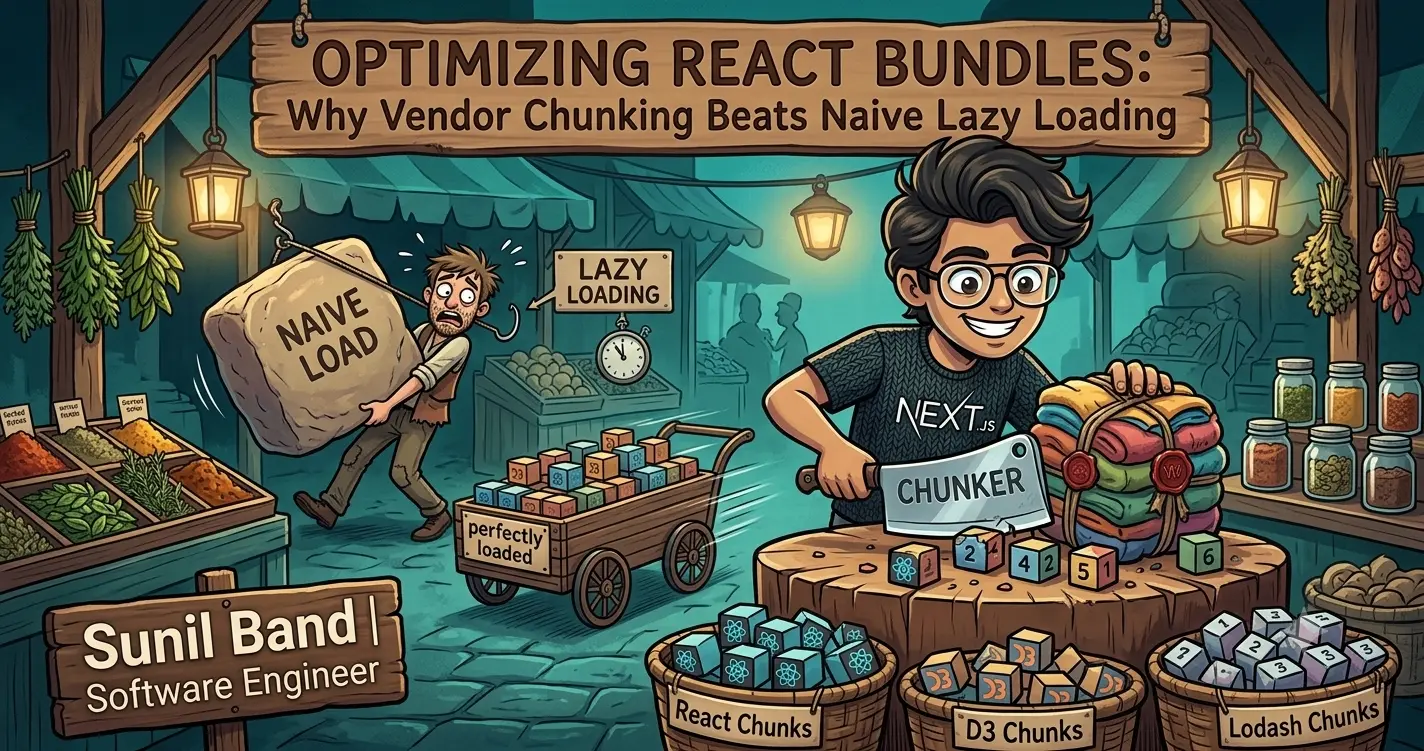
Optimizing React Bundles: Why Vendor Chunking Beats Naive Lazy Loading
Lazy loading is great, but splitting your bundle into arbitrary component chunks often misses the bigger picture. Vendor chunking, on the other hand, strategically isolates stable dependencies, leading to better cache hit rates and a genuinely faster user experience.

Next.js 16: Every Major Optimization You Need to Know
Next.js 16 replaces Webpack with a stable Turbopack, introduces the use cache directive for explicit caching, ships React Compiler support, and overhauls routing with layout deduplication — making it the most performance-focused release in the framework's history.